Category: AI

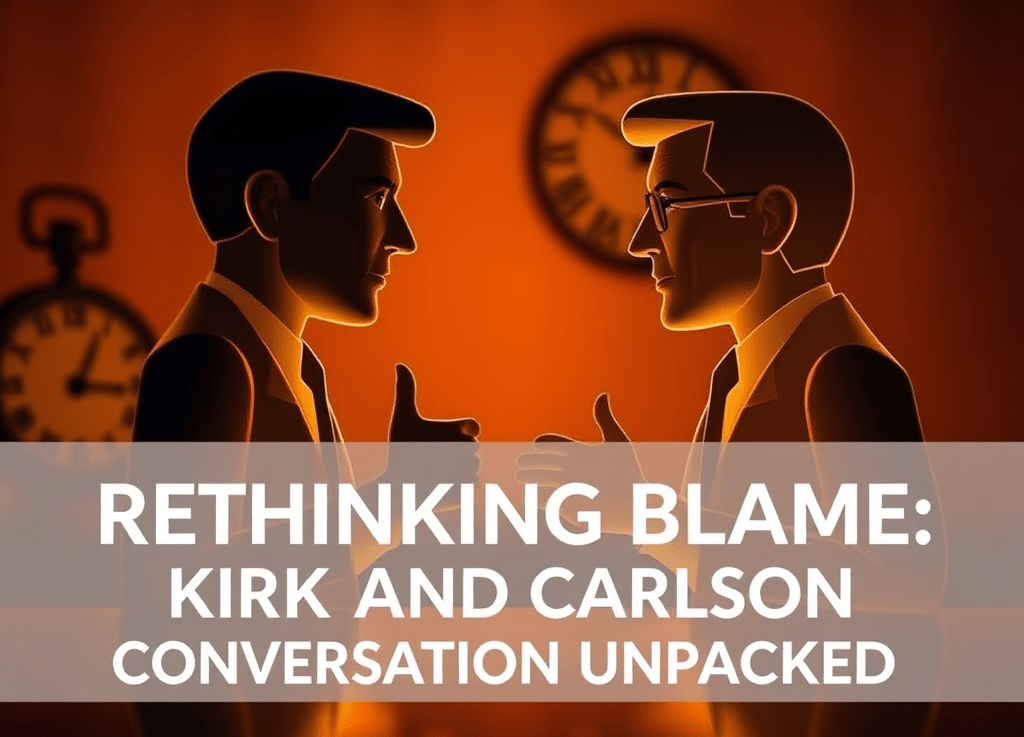
Rethinking Blame: Kirk and Carlson’s Conversation Unpacked

Rethinking Blame: Kirk and Carlson’s Conversation Unpacked

The recent interview between Charlie Kirk and Tucker Carlson warrants closer scrutiny, particularly in light of the significant influence both figures wield in shaping public discourse. While the conversation touched on a variety of topics, including generational blame, political strategy, and cultural values, it also revealed certain rhetorical tendencies and ideological positions that merit critical reflection and, perhaps, a reevaluation of their approach.


Generational Blame and Oversimplification

One of the central themes of the interview was the critique of Baby Boomers, with both Kirk and Carlson suggesting that this generation bears significant responsibility for the economic and cultural challenges faced by younger generations, particularly Gen Z. This argument, while provocative, risks oversimplifying complex systemic issues. As noted in the transcript of the interview titled “How Debt Has Radicalized Young America and Why Boomers Deserve the Blame”, Kirk and Carlson discuss how debt and economic inequality have disproportionately impacted younger generations, framing Boomers as a primary cause 

.While it is true that certain policies and decisions made during the Baby Boomer era have contributed to current economic challenges, attributing blame to an entire generation ignores the diversity within that cohort. Many Boomers were not in positions of power and faced their own economic struggles. Furthermore, systemic issues such as rising debt, economic inequality, and environmental degradation are the result of decisions made by individuals across multiple generations, not solely by Boomers. This kind of generational scapegoating risks alienating potential allies and oversimplifying the root causes of these problems.


Inflammatory Rhetoric and Its Consequences

Another point of concern is the tone and language used during the interview. Tucker Carlson, known for his provocative style, reportedly used inflammatory language, including a call to “lock those [expletive] up,” which was met with visible discomfort from Kirk, as noted in the interview. While Carlson’s rhetoric may resonate with certain segments of his audience, it raises questions about the broader implications of such language in public discourse.Inflammatory rhetoric, while effective in capturing attention, can undermine constructive dialogue and alienate individuals who might otherwise engage with the issues being discussed. It also risks reinforcing the very dynamics of power and division that Carlson and Kirk often critique. As public figures with significant platforms, both men have a responsibility to foster thoughtful and inclusive conversations rather than resorting to language that exacerbates polarization.


The Role of Self-Reflection in Public Discourse

Given the influence of both Carlson and Kirk, it is crucial for them to engage in self-reflection and consider the broader impact of their messaging. While their critiques of cultural and political elites often resonate with audiences who feel disillusioned or marginalized, they must also ensure that their arguments are grounded in nuance and avoid perpetuating division. For instance, Carlson’s reflections on religion and values, as highlighted in the interview, offer an opportunity to emphasize unity and shared purpose rather than focusing on blame or conflict.Moreover, Kirk’s role as a voice for younger generations could benefit from a more balanced approach that acknowledges the contributions and struggles of older generations while advocating for systemic change. By fostering intergenerational collaboration and emphasizing shared goals, Kirk and Carlson could help bridge divides rather than deepen them.


The recent interview between Charlie Kirk and Tucker Carlson provides a valuable opportunity to reflect on the role of public figures in shaping societal narratives. While their critiques of generational and systemic issues raise important questions, their reliance on oversimplification and inflammatory rhetoric risks undermining the constructive potential of their platform. A more nuanced and inclusive approach, grounded in self-reflection and a commitment to fostering unity, would better serve their audience and contribute to meaningful progress on the issues they seek to address.

Navigating the Challenges of Writing in the AI Era

Navigating the Challenges of Writing in the AI Era

I had lunch with a dear friend recently—a lovely person who discovered that writing is, in fact, a business. Yes, a business. Like selling hot dogs or running a laundromat, except with more existential dread and fewer health inspections. Over sandwiches, we discussed the latest in literary absurdity: AI-driven software that can crank out an entire book faster than you can say, “What the actual fuck?” Apparently (and I can’t confirm this, but it sounds stupid enough to be true), Kindle Direct Publishing (KDP) now limits authors to uploading no more than three books a day. Three. A. Day. Because, you know, that’s a totally normal output for a human being and not at all a sign that Skynet is moonlighting as a romance novelist.

Let’s talk about writing a book the way most authors do—or at least the way we used to before AI started pooping out novels like a malfunctioning vending machine. Writing a book used to be a deeply personal, soul-crushing process that required creativity, discipline, and the kind of stubbornness usually reserved for toddlers refusing to eat broccoli. Here’s how it went down in the pre-AI era:

1. Generating Ideas

Back in the day, authors had to rely on their own brains to come up with ideas. No ChatGPT, no Bard, no “AI Muse 3000.” Just raw, unfiltered human creativity. Inspiration came from life experiences, dreams, or that one weird conversation you overheard at Starbucks where someone said, “I don’t care if it’s illegal, I’m marrying the ferret.” Writers carried notebooks everywhere, jotting down ideas like lunatics scribbling manifestos.

For example, when I wrote a book about sailing, I didn’t just Google “how to sail” and call it a day. No, I lived it. I chartered a sailboat, had the crew walk me through the process, and spent the day pretending I was Captain Jack Sparrow (minus the eyeliner and rum). That night, when I lay down in my hotel bed, the room was still swaying. That’s the kind of detail you can’t fake. That’s world-building, baby.

2. Outlining the Story

Once you had an idea, you had to outline it. This was where the real masochism began. You’d map out the plot, develop characters with backstories more complicated than your family drama, and, if you were writing sci-fi or fantasy, create entire worlds with their own rules, languages, and economies. It was like playing God, except no one worshipped you, and you didn’t get a day off.

Some writers “pantsed” their way through the story (a.k.a. winging it like a drunk pilot), while others meticulously planned every chapter. I personally use a beat sheet from Save the Cat, because apparently, I enjoy turning my creative process into a spreadsheet. Nothing says “art” like Excel.

3. Writing the First Draft

Ah, the first draft. The part where you sit down, stare at a blank page, and think, “Why the hell did I decide to do this?” Writing was slow, painful, and required the kind of discipline usually associated with monks or Navy SEALs. You’d aim for a specific word count each day, and if you hit it, you’d reward yourself with chocolate or alcohol—or both.

Writer’s block was a constant companion. Without AI to suggest ideas, you had to push through it on your own. Some people went for walks. Others screamed into the void. I personally found inspiration in coffee, wine, and the occasional existential crisis.

4. Revising and Editing

Once the first draft was done, the real torture began: revising. You’d read your manuscript over and over, catching typos, fixing plot holes, and wondering why your protagonist sounded like a cardboard cutout. Beta readers would give you feedback like, “I didn’t connect with the characters,” or “This part was boring,” and you’d resist the urge to reply, “Well, Karen, maybe you’re boring.”

If you could afford it, you’d hire a professional editor. If not, you’d edit it yourself, which was like performing surgery on your own child. Painful, messy, and guaranteed to leave scars.

5. Research

Research is the necessary evil of writing, especially for non-fiction or historically accurate fiction. It’s the part of the process where you willingly dive headfirst into a rabbit hole of facts, only to emerge hours later wondering why you now know the mating habits of 18th-century pigeons but still haven’t figured out what your protagonist’s name is. Research is both a blessing and a curse—it gives your work depth and believability, but it also makes you question your life choices when you’re Googling things like, “How long does it take for a body to decompose in a swamp?” and praying your internet provider isn’t judging you.

For example, if you’re writing sci-fi, you might find yourself studying quantum physics or emerging technologies, which sounds impressive until you realize you’re just trying to figure out how to explain time travel without sounding like a lunatic. Or, if you’re me, you might Google “how to sabotage an airplane” and then spend the next week convinced that the FBI is about to kick down your door. I mean, imagine it: covert agents taping over your outdoor cameras, RF jamming your phone so you can’t call for help, cutting the power to your house, shooting your dogs (RIP, Fido), and snipers perched in trees a mile away, just waiting for you to answer the door in your pajamas—or, let’s be honest, nude—so they can interrogate you about your questionable search history.

Wait. I never Googled that. Nope. Never happened. But damn, wouldn’t that make a killer chapter in a thriller? Picture it: the protagonist is a writer who accidentally stumbles onto some classified government conspiracy while researching their next book. Suddenly, their innocent Google searches turn into a one-way ticket to paranoia-ville, complete with black SUVs tailing them and mysterious men in suits showing up at their local coffee shop. Someone call Netflix—I think I just wrote their next hit series.

But seriously, research is the backbone of good writing. Whether you’re crafting a historical epic or a sci-fi adventure, you need to know your shit. As Patricia Leslie points out, research is essential for both fiction and non-fiction writers. It helps develop characters, make settings believable, and weave fact and fiction together so seamlessly that readers can’t tell where one ends and the other begins

For non-fiction, accuracy is king. For fiction, it’s more like a benevolent dictator—you can bend the rules a little, but you still need to know what you’re doing.

The trick is to use research as a tool, not a crutch. Sure, you could spend weeks poring over vintage newspapers or interviewing experts, but at some point, you have to stop researching and start writing. Otherwise, you’ll end up with a head full of useless trivia and no book to show for it. And let’s be honest, no one’s going to be impressed that you know the exact dimensions of a 16th-century guillotine unless you actually use that knowledge in your story.

So, to all the writers out there: research responsibly. And maybe clear your browser history every now and then, just in case. You never know when the FBI might decide to pay you a visit.

6. Finding a Publisher

Before self-publishing, authors had to grovel at the feet of literary agents and publishers. You’d write query letters, pitch your book, and wait months for a response, only to get a rejection that said, “Not for us, but good luck!” It was like online dating, except instead of ghosting you, they sent a polite “no.”

7. Marketing and Promotion

Even after all that, the work wasn’t done. Authors had to promote their books like used car salesmen. Book tours, media appearances, social media campaigns—you name it. You’d beg people to buy your book, and they’d say, “I’ll wait for the movie.” Thanks, Aunt Linda.

The AI Problem

Now, thanks to AI, anyone can “write” a book in minutes. But let’s be honest: these programs aren’t writing books; they’re shitting them out. And the result? A flood of mediocre, soulless content clogging up the literary world like a fatberg in a sewer.

I’m all for technology as a tool. Word, Grammarly, ProWritingAid—these are great. But AI-generated books? That’s where I draw the line. I’m pushing for legislation that requires AI-generated books to wear a big, ugly label that says, “This was written by a robot.” Readers deserve to know if the “author” of their favorite romance novel is a human or a glorified toaster.

Final Thoughts

Writing is a job. A hard, thankless, occasionally soul-sucking job. There are days when I stare at my manuscript and think, “Why am I doing this?” But then I remember: because I love it. Because it’s who I am. And because the world needs more books written by real people with real stories to tell.

My book, Stupid Shit, is coming soon. Subscribe today so you can grab a copy when it drops. Trust me, it’ll be worth it. Or don’t. I’m not your mom.

-Best

The Ethical Dilemmas of AI and Legal Professionals

The Ethical Dilemmas of AI and Legal Professionals

The subsequent analysis presents my reflections on artificial intelligence following Mr. Kennedy’s inquiry to AI specialists.

Prior to offering my perspective, which I consider to be self-evident, it is necessary to consider expert opinions on gain-of-function viral research and the wisdom of developing weapons of mass destruction.

It is imperative that we discuss the legislators. The preponderance, if not the totality, of them are legal professionals. Allow yourself time to fully comprehend this. I contend that the legal profession often lacks ethical principles. Morality is linked to self-interest and the potential financial gain from persuading others to adopt and act on one’s beliefs.

Alternatively, what comparative analysis is needed to validate my stance relative to my opponent’s?

Two pertinent examples remain vividly in my memory.

Alternative 1: In my initial role as an engineer in a prominent law firm, the senior partner invested time in building a rapport with me. From my perspective, his office was in a state of disarray. The 34th floor of the office building resembled those often depicted in “Boston Legal,” though it was distinguished by files scattered across the floor, pertaining to various cases.

In reference to a defendant, he stated, “My ability to secure an acquittal is enhanced by an understanding of your guilt.” In plain English, it was easier for him to get you off if you told him you were guilty.”

His statement resonated deeply with me during my elevator descent from his office that afternoon.

The following case. A colleague in the same field as the first case had incurred the displeasure of a lawyer due to a professional error. I frequently responded to cases involving highly dissatisfied clients.

I was approached by a short, thin lawyer as I entered his office. His behavior escalated to include shouting, ranting, spitting, and threats of litigation. In short, he exhibited extreme narcissistic traits and behaved in a reprehensible manner.

A small notebook and pen were consistently kept in my shirt pocket. While he delivered his intimidating pronouncements against my company and myself, I made notes, allowing him to express his grievances. 

His discourse concluded; I ceased my doodling and calmly inquired, “Have you finished?”

His reaction was akin to that produced by a sudden immersion in cold water.

“You didn’t buy that?” He asked.

My professional engagements are exclusively limited to physicians and legal professionals.

Why this dissertation on lawyers?

Numerous legal professionals serve in both the House and the Senate. Shockingly, a few are not that smart, like an ex-bartender we all know.

When you wonder why the world is so screwed up, that is your reason. Many, not all make decisions on “what is in it for me?” Those are the ones who need to be primaried, and that is also why we need term limits. It would be beneficial to have clear financial transparency. When people all over the country are forced to decide whether to buy their medicine or eggs, that is a problem.

Serve your country for a limited time, then rejoin the real world and engage with the frustrations and anger of the people, instead of remaining aloof in your privileged position.

Now, let’s talk about AI.

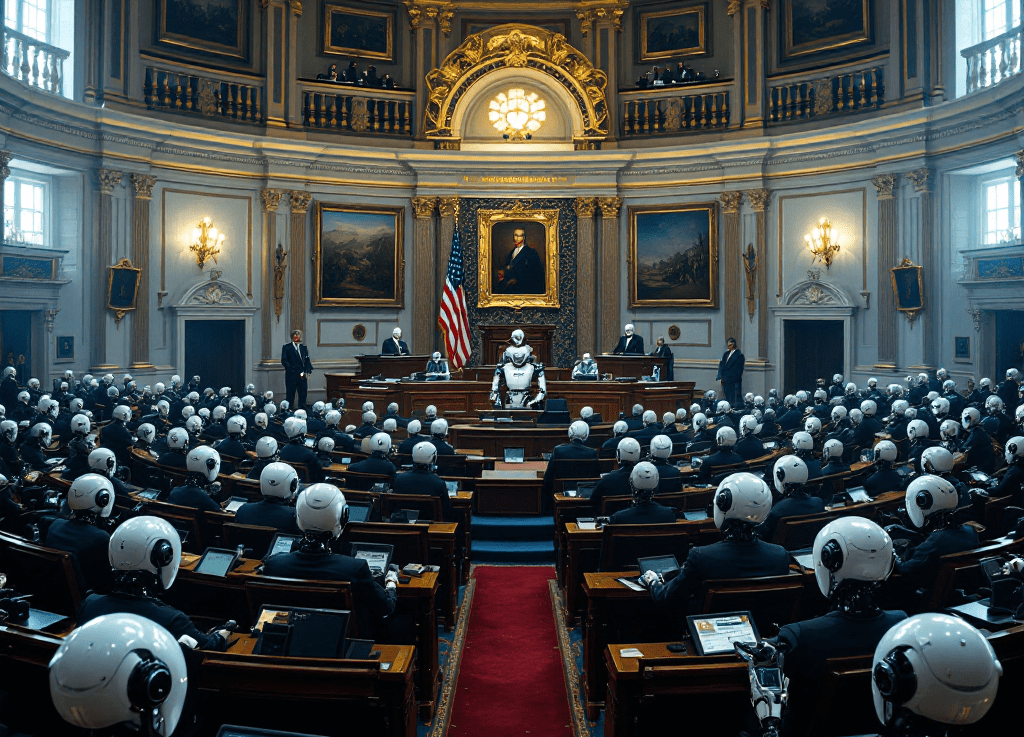
AI needs an off switch. Period.

Any AI incorporated in mechanical devices not only needs an off switch but must also have a dictum that it cannot get around: “Thou shall not kill.”

No robots of any kind shall be a replacement for police, soldiers, or peacekeeping devices.

No AI should possess the ability to rewrite its own code. Creators of such code, like the coronavirus, should be held accountable; furthermore, I would require them to be licensed.

A non-corrupt agency must be created to handle licensing.

AI has a similarity to the Vietnam War. “What?”

Think about it. The Vietnam War was a no-win scenario. Why would AI become a no-win scenario?

As much as we regulate it here in the States, I can guarantee that other countries will only see it, much like lawyers who skirt the laws for their personal advantage; what can I get out of it? How would AI put my country ahead of other countries? How could AI give me an advantage?

Much like Iran and other countries seeking nuclear bombs, the use of such would mean the end of humanity, and any sane person knows this. Yet they spend billions of dollars on building such things, and some foolish person somewhere wants more of them, just like some impotent men get a fast car to replace their inability to impress a girl.

The application of artificial intelligence to research, particularly its capacity for high-speed analysis of extensive datasets, presents significant advantages. I believe that AI might find a cure for cancer or be able to come up with solutions for complicated legal issues.

AI-driven automation will inevitably lead to job losses.

Granting artificial intelligence the authority to make life-or-death decisions based on algorithms of unknown origin is ill-advised.

Much like many programs today, the output is only as good as the input. When I asked AI to tell me about Tim Walz when Kamala chose him, the output would make you think he was an all-American hero who Jesus himself would be proud to call brother.

In contrast, research concerning right-leaning political figures is far less optimistic, suggesting inherent biases within AI systems.

One final thought about those who walk DC hallowed halls and believe they are more intelligent than their bosses.

Why would a man spend $19 million of his own money to get elected to a congressional seat that pays less than $200,000 a year?

How do some people of modest means get elected and now worth millions?

My final head-scratcher is how Kamala Harris got and spent over a Billion dollars for an election that had a zero chance of winning, even with the media spreading vitriol for Trump and over half the American people.

Who is running the country?

I hope sanity prevails in Washington, D.C., soon.

To be completely transparent, I’m a multi-genre author and a creative thinker. Challenges like this demand my attention before I can return to my fictional worlds, where even the final frontier is a stepping stone in my search for extraterrestrial intelligence.

You can find my books here.