Considering that roughly 216 million people shop at Walmart, one might ponder the sheer number of stores. The number of stores hovers near 4,500.
I don’t need to tell you that Walmart is responsible for the death of many mom-and-pop shops in small town america. Now Amazon is killing what is left. Do you remember the friendly face behind the counter the one that might ask you about your family or even know your name?
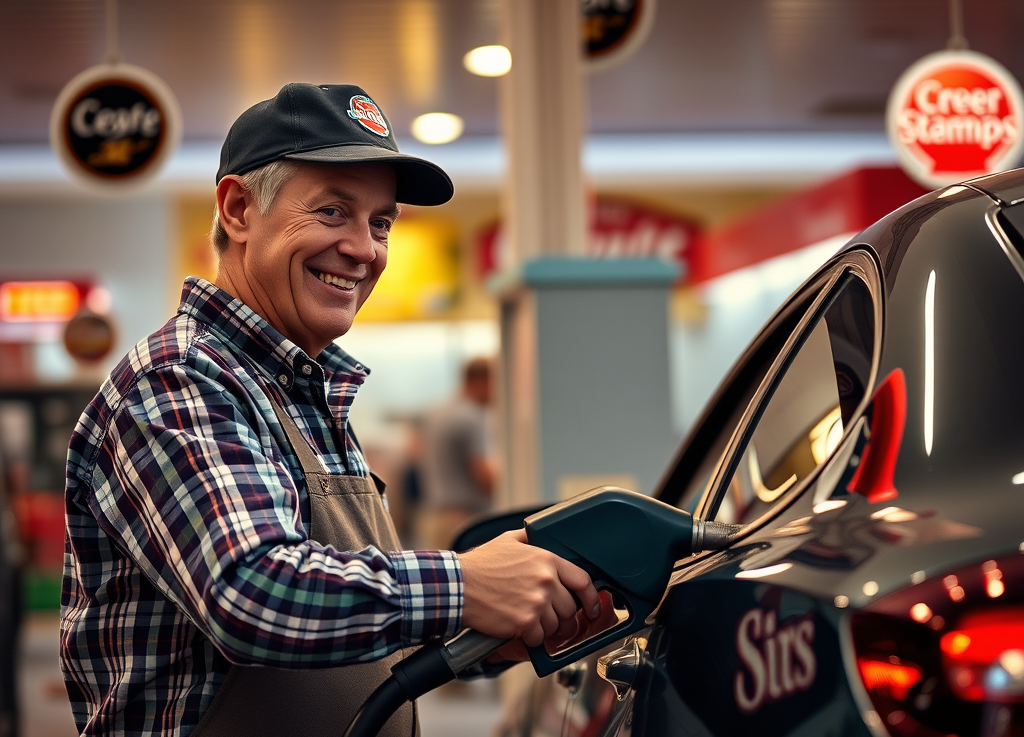
Not that long ago, I’d pull up to the filling station and, before I could even step out of my car, an attendant would be at my window with a friendly smile. They’d fill my tank for me, and if I asked, they’d wash my windows until they sparkled, check the air in my tires, and even pop the hood to make sure my oil was topped off. It felt like a small ritual of care, when someone else looked after both me and my car.
I still remember the little extras that made stopping at the gas station feel special. Not only would they fill my tank and check my tires, but I’d also collect S&H Green Stamps with every purchase. I’d save them, sticking them into those little booklets, dreaming of what I could redeem them for. Some stations even had promotional giveaways—maybe a glass, a bowl, or some other small treasure to take home. It felt like they truly valued my business.
And honestly, when you think about it, gas stations make money on every gallon sold. So why not have someone there to give you that little something extra? It wasn’t just about the gas—it was about the experience, the care, and the feeling that you mattered as a customer.
I’ve learned that the federal tax on gasoline has been stuck at 18.4 cents per gallon since 1993—unchanged for over three decades. For diesel, it’s higher at 24.4 cents per gallon. It’s strange to think about how much has changed since then, yet this tax has stayed the same, even as inflation has chipped away at its real value.
When it comes to gas stations, I was surprised to find out that they only make about 10 to 15 cents per gallon in profit after covering all their expenses—things like credit card fees, utilities, and employee wages. Sure, the markup on gas might be around 30 cents per gallon, but most of that gets eaten up by operating costs. In the end, the station itself is left with just a small slice of the pie. Of course, this can vary depending on where the station is, how much competition it has, and other factors.
And then there’s the total tax burden on gas. When you combine the federal tax with state taxes, it adds up. On average, state gas taxes are around 32.26 cents per gallon, which means the total tax—federal and state combined—comes out to about 50.66 cents per gallon as of mid-2023. It’s wild to think that over 50 cents of every gallon I pump goes straight to taxes!
As of July 1, 2025, I’m paying 61.2 cents per gallon in state gas taxes here in California. That’s the highest in the entire country, and it’s not just the excise tax—though that alone went up by 1.6 cents from the previous 59.6 cents per gallon. On top of that, there are all these other fees, like sales tax and underground storage tank fees, which push the total tax burden on every gallon of gas to over $1.15. It’s mind-blowing when you think about it.
Honestly, I can’t help but wonder how California hasn’t turned into a ghost state by now. With gas prices this high, it feels like only the Hollywood elite could afford to stick around. Meanwhile, the rest of us are left shaking our heads at the pump, wondering where all this money is going.
These days, I do it all at the gas station. I’m pumping my own gas, washing my own windows, and if I decide to step into the store, there’s a good chance I might not even understand the person behind the counter. It’s a far cry from the days when someone would come out, take care of everything for me, and maybe even throw in a smile or a little conversation. Now, it feels like I’m on my own, just another part of the self-service world we’ve all grown used to.
After finishing my transaction, I think what irritates me the most is that cold, robotic “THANK YOU” that comes from some computer chip with absolutely zero agency. It’s not a person expressing gratitude—it’s just a programmed response, a hollow echo of politeness designed to mimic human interaction. I know it’s just a chip running instructions, processing inputs, and spitting out outputs, but it feels so empty. It’s like the machine is trying to replace the human touch, and instead, it just reminds me how far we’ve drifted from real, meaningful interactions.
I can still remember a time when going to the grocery store felt like a completely unique experience. Back then, I’d push my cart through the aisles, and when I was done, someone would take it from me and handle everything. They’d ring up my order, carefully bag or sack the groceries, and then, as if it were the most natural thing in the world, someone would carry them out to my car. They’d even ask where I wanted them placed—trunk, backseat, wherever—and do it with a smile.
It wasn’t just about the service; it was the warmth of the interactions. There were genuine “pleases” and “thank you’s,” and as I drove away, I felt appreciated, like my business actually mattered. It wasn’t just a transaction—it was a moment of connection, a small but meaningful exchange that made the whole experience feel human. Now, I can’t help but miss those days, when customer service wasn’t just a buzzword but something you could feel in every interaction.
Today, things couldn’t be more different. Now, there’s an app for everything—even grocery shopping. I’m expected to pull out my phone, open the app, and start scanning my groceries as I pick them out. I place them in my cart myself, and when I’m ready to leave, I just show the machine a barcode on my phone. And Voila—transaction complete. It feels a lot like shopping at Aldi or one of those other stores where you’re left to bag, box, or otherwise pack your own groceries for the ride home.
As I glance around, I see several employees standing around, not ringing people up or bagging groceries, but instead directing traffic or helping someone with an item that refuses to scan properly. Is it quicker? Sure, sometimes it is. But can it be slower? Oh, absolutely. The entire process feels so detached. What used to be a personal, interactive experience now feels like I’m just another cog in a self-service system, where the human touch has been replaced by machines and apps.
Here’s the bottom line: H-E-B and Tom Thumb are the only places around here that still have full-service stores. So, I’ve decided to run a brief experiment. I’m going to visit each one and rate them on three things: price, availability of products, and the overall customer experience. Because let’s face it, prices are already way too high, and shrinkflation is everywhere. If I’m going to get screwed over, I’d at least like a little courtesy to go along with it—give me a kiss afterward, you know?
What I mean is, when I leave the store, I don’t want to walk out feeling frazzled, pissed off, and frustrated by the total incompetence of the people they hire. I just want a real person to look me in the eye, maybe smile, and say, “Thank you, have a great day.” Is that too much to ask? What do you think? Let me know your thoughts—because at this point, I’m starting to wonder if I’m expecting too much, or if the world’s just forgotten how to care.
Discover more from TheTimeDok
Subscribe to get the latest posts sent to your email.
