The Covid Fever by Scott Taylor
The woman’s hands burned against my spine—not the good burn of muscle releasing, but something older, stranger. I felt it enter through the skin.
“You feel that?” I asked.
She said nothing. Her Mandarin would have been useless to me anyway. Sweat beaded on her forehead despite the sixty-eight-degree room, and I watched a single drop fall onto my shoulder blade where it hissed, briefly, like water on a summer stone.
I should have known then.
“You’re warm,” I said. “Are you sick?”
She pressed her thumb into the scar tissue beneath my ribs—the place where the drunk driver’s sedan had rearranged my organs thirty years before—and I saw it: a thin red thread trailing from her breath, drifting toward my open mouth. It hung in the air the way dust motes do in late afternoon light, almost beautiful.
I inhaled.
The fever dreams came three nights later, vivid as prophecy. I stood in a city of masks, millions of faces covered, and watched the thread multiply—splitting and splitting until it webbed the whole world in crimson. A woman in a car screamed at me through her window, but I couldn’t hear her. A man on a motorcycle wove between the threads, helmetless, grinning.
“You’re not wearing protection,” my wife said, appearing beside me in the dream.
“Neither is he,” I said, pointing to the motorcyclist.
“He’s already dead,” she replied. “He just doesn’t know it yet.”
I woke with my throat on fire and a rash climbing my arms like ivy.
Dr. Chen examined my feet two weeks later, frowning at the purple discoloration on my toes.
“COVID toes,” she said, as though naming a new species. “You’re one of the early ones.”
“Early ones?”
“The thread-touched.” She wrote something on her clipboard. “You’ll carry it now. The mark doesn’t fade.”
I looked down at my feet. The purple had arranged itself into a pattern—forking lines like a river delta, or perhaps like the branching of a virus seen under a microscope.
“What does it mean?” I asked.
She smiled, but it didn’t reach her eyes. “It means you survived. That’s all survival ever means.”
Outside her window, I watched a red thread drift past, catching the light.
The Needle’s Bargain
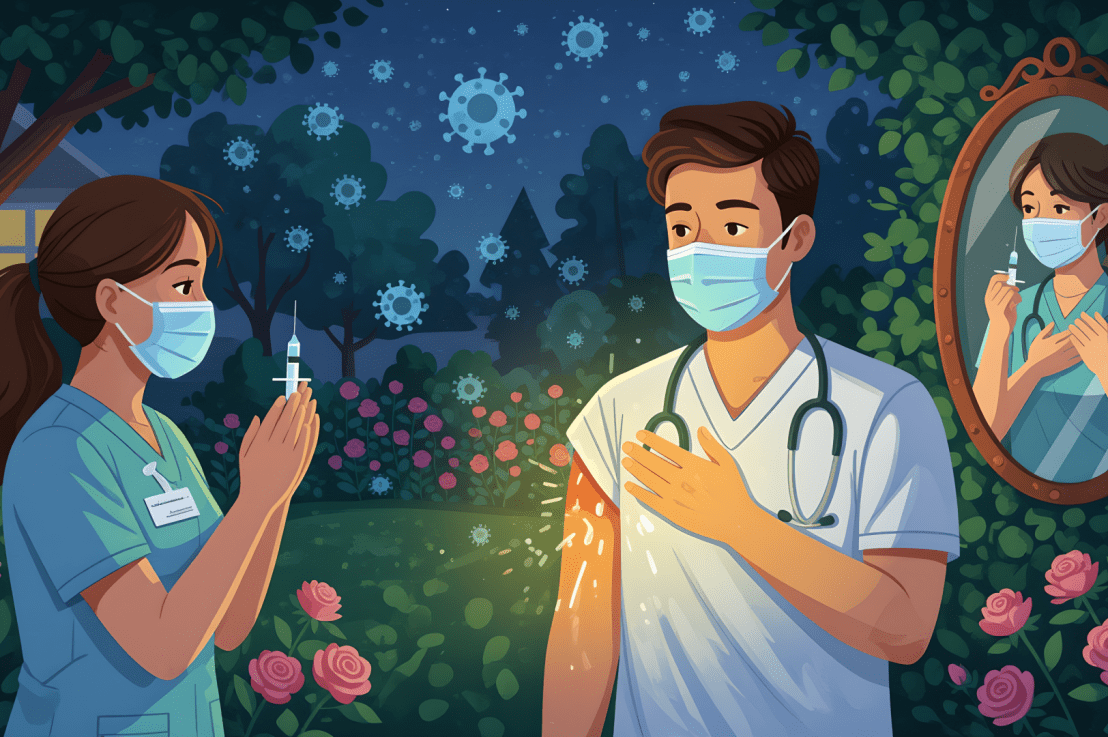
The vaccination center smelled of antiseptic and something else—ozone, maybe, or the particular electricity of collective fear. We stood in lines that snaked through a converted gymnasium, each of us clutching appointment cards like tickets to uncertain salvation.
“Roll up your sleeve,” the nurse said. She didn’t look at my face.
“Which arm is better?”
“Doesn’t matter.” She drew the liquid into the syringe, and I watched it catch the fluorescent light. For a moment—just a moment—it shimmered gold, like something precious. Like a promise.
Then she jabbed.
“Jesus—” I jerked back. “You hit bone.”
“Hold still.” She pressed the plunger anyway.
I felt it enter: not just the vaccine, but something else. A cold that spread from the injection site down through my chest, branching like frost on a window. When I looked down at my arm, I could see it moving beneath the skin—silver threads racing toward my heart.
“Is that normal?” I asked.
She was already calling the next number. “Fifteen minutes in the observation area. If you don’t collapse, you’re fine.”
My wife found me that night in the bathroom, staring at my reflection.
“What are you doing?”
“Looking.” I pulled down my shirt collar. The silver threads had surfaced near my clavicle, forming delicate patterns like circuit boards. “Can you see them?”
She squinted, leaned closer. “See what?”
“The lines. Right here.” I traced them with my finger.
“There’s nothing there, honey.” She touched my forehead. “You’re warm. Maybe you should lie down.”
But I could see them. I could see them spreading.
The Fog
The cardiologist spoke in a voice designed for delivering bad news—soft, measured, with strategic pauses.
“Myocarditis,” he said. “Inflammation of the heart muscle.”
“From the vaccine?”
Another pause. “We’re seeing it in some patients. Rare, but not unheard of.”
“And these?” I held out my hands. The silver threads had reached my fingertips now, visible only to me, pulsing faintly with each heartbeat.
He examined my palms, frowning. “I don’t see anything unusual.”
“The patterns. Like veins, but silver.”
He made a note on his chart. “Brain fog is another reported side effect. Confusion, visual disturbances.” He looked up. “Are you sleeping?”
I laughed—a hollow sound. “When I sleep, I dream of red threads. When I’m awake, I see silver ones. Which would you prefer?”
The fog descended slowly, like weather moving in from a distant coast.
At first, it was small things: forgetting where I’d left my keys, losing words mid-sentence, standing in rooms without knowing why I’d entered. Then the gaps grew wider. Hours would vanish. I’d find myself in the garden at dusk, dirt under my fingernails, with no memory of planting anything.
“You were talking to the roses,” my wife said one evening. “For almost an hour.”
“What was I saying?”
“I couldn’t hear. But they were listening.” She handed me a glass of water. “The red ones were leaning toward you.”
I looked out the window. The roses—which I didn’t remember planting—had indeed turned their blooms toward the house. Toward me.
“They’re infected too,” I said.
“The roses?”
“Everything.” I could see it now: thin red threads connecting each flower to the next, running through the soil, climbing the fence posts, stretching toward the neighbor’s yard and beyond. The whole world, stitched together with virus.
My wife took my hand. “Maybe you should stop looking.”
“I don’t know how.”
***
I found others like me in the waiting rooms of specialists, in the comments sections of articles no one else would read, in the eyes of strangers who held my gaze a moment too long.
There was Marcus, a former marathon runner whose legs now traced with gold instead of silver—a different vaccine, a different pattern, the same bewilderment.
“Can you see them?” he asked, the first time we met in the parking lot of a blood clinic.
“The threads?”
He exhaled. “Thank God. My wife thinks I’m losing my mind.”
“Maybe we are.”
“Maybe.” He rolled up his sleeve. The gold lines spiraled from his wrist to his elbow, intricate as manuscript illumination. “But if we’re both losing it the same way, doesn’t that make it real?”
We started meeting weekly—Marcus, myself, and eventually others: Linda with her copper tracery, Ahmed whose patterns shifted colors with his mood, young Sophie who’d been marked at twelve and saw not threads but wings unfolding beneath everyone’s shoulder blades.
“What do the wings mean?” I asked her once.
“How ready they are,” she said.
“Ready for what?”
She looked at me with eyes too old for her face. “To leave.”
***
The nurse at my general practitioner’s office still wore her mask in late 2024, long after most had abandoned theirs.
“You know those don’t work,” I said. It came out sharper than I intended.
She stiffened. “They’re recommended.”
“Give me your hand.”
“Excuse me?”
“Just—here.” I took the bottle of scented sanitizer from the counter and squeezed some onto her palm. “Now smell your hands. Through the mask.”
She hesitated, then raised her hands to her face. Inhaled.
“Can you smell it?”
A pause. “Yes.”
“Those molecules—the ones carrying that lavender scent—they’re larger than the virus particles. Much larger.” I leaned back. “So what exactly is the mask catching?”
She pulled the cloth down from her nose, and I saw—briefly, flickering—a cloud of red threads escaping with her breath. She’d been carrying them all along. We all had.
“You can see it too,” she whispered. “Can’t you?”
I nodded.
She put the mask back on, hands trembling. “I’d rather not.”
***
I stopped asking doctors for answers. The answers lived elsewhere now—in the patterns themselves, in the spaces between breaths, in the dreams that came whether I wanted them or not.
One night, I dreamed of a man in a white coat, standing at a podium beneath a sky filled with branching red.
“Why?” I asked him.
He smiled. “The species was overgrown. Too many threads tangled together. We simply… pruned.”
“Millions died.”
“Millions die every year.” He gestured to the sky. “We just gave it a name. A face. Something to fear.” He leaned closer. “Fear is its own kind of virus, you know. It spreads faster than any pathogen. It changes behavior. It creates compliance.”
“Was it the virus or the cure?”
“Does it matter?” He began to fade. “You’re marked either way. You survived. That’s the only question that ever mattered.”
I woke with the song in my head—that old Bobby McFerrin tune, absurdly cheerful, a relic from a world that no longer existed.
Don’t worry. Be happy.
***
The threads never faded. If anything, they grew more vivid with time.
Marcus stopped seeing his gold after the third booster—said it burned away, left behind something like scar tissue in his vision. Linda’s copper turned green, then vanished entirely. Ahmed’s colors settled into a permanent amber.
Mine stayed silver. My wife learned to believe in them, eventually—not because she could see them herself, but because she could see me seeing them. She learned to read my face when the patterns shifted, to know when the fog was rolling in, to sit with me in the garden when the roses started whispering.
“What do they say?” she asked one morning.
“That it’s not over.”
“The pandemic?”
“The change.” I touched a petal, watched the red thread pulse beneath its surface. “We’re different now. All of us. Whether we can see it or not.”
She took my hand—the one laced with silver, the one that would never again be simply mine.
“Different isn’t dead,” she said.
“No,” I agreed. “It’s not.”
The roses turned toward us. The threads hummed. Somewhere, a new variant was learning its name.
And the world, marked and woven and strange, kept spinning anyway.