
Elena had forgotten the sound of her own breathing. Forty-seven years of city noise, deadlines, and the electric hum of fluorescent lights had buried it somewhere beneath layers of static, pressed into that velvet darkness where forgotten things take root and wait.
So when her doctor (a soft-spoken woman whose silver-threaded hair caught light that wasn’t there, holding it like small, patient ghosts) told her to “find stillness,” Elena drove until the road turned to gravel and the gravel turned to sand.
The highway signs began to lose their letters somewhere past the third town, words slipping away like names from an aging tongue. She did not find this strange. The sand, when she finally stopped, hummed a frequency just beneath hearing, a sound her lungs seemed to recognize before she did. When she inhaled, truly inhaled, the breath tasted of salt and years, and something inside her chest unfolded like a letter she had written to herself long ago and never sent.
The beach was unremarkable at first glance. Gray-blue water. Foam curling like lace against the shore.
A weathered wooden bench that seemed to have grown from the dunes rather than been placed there; its grain twisted in the same spirals as the seagrass, its wood soft and salt-worn, remembering tides it had no business knowing.
She sat.
For the first hour, nothing happened. Her mind churned with grocery lists and unanswered emails, those small tyrannies of the living. But as the sun dipped lower, painting the clouds in shades of apricot and rose, Elena noticed something peculiar.
The waves were speaking.
Not in words, exactly, but in rhythm; a language older than syllables, older than the naming of things. And stranger still, she understood them. Each wave that kissed the shore carried a message: Let go. Let go. Let go. The words arrived not through her ears but through her sternum, settling into her ribs like birds returning to a familiar roost.
She laughed, thinking herself foolish.
But then she saw the herons. Three of them stood in the shallows, perfectly still, their reflections unbroken on the water’s surface (as if the sea had chosen, just for them, to hold its breath). And as Elena watched, they turned their long necks toward her in unison, not with curiosity, but with recognition, as though they had been waiting for her all along, as though her name had been written in the tide charts for forty-seven years.
Over the following days, Elena returned to the bench. She learned that if she sat quietly enough, the sea would show her things. Memories rose from the water like mist: her grandmother’s hands kneading bread (flour dusting the air like small, edible stars), her daughter’s first steps, a summer evening when she’d felt, for one perfect moment, completely whole. These visions arrived without explanation, and Elena did not ask for one. The sea gave what it chose to give.
The tide pulled her grief out gently, grain by grain, carrying it past the breakwater to wherever sorrow goes when it is finally ready to leave.
One morning, an old man appeared beside her. His skin was weathered like driftwood, and his eyes held the silver of deep water; not the color of it, but its weight, its patience, its memory of every drowned thing it had ever cradled. He smelled of salt and woodsmoke and something older, something before.
“You’re learning,” he said.
“Learning what?”
He smiled and gestured toward the endless horizon, where the sky stitched itself to the sea with threads of light. “That peace isn’t something you find. It’s something you become when you stop running from the silence.”
When Elena turned to respond, he was gone. In his place, a single white feather rested on the bench, still warm, as though it had only just remembered how to be still.
She never told anyone about the speaking waves or the herons or the old man who might have been the sea itself wearing a human shape, trying on bones and breath the way one tries on an old coat. Some truths aren’t meant for telling; only for carrying, quietly, like a stone smoothed by centuries of water. They live best in the body’s hidden rooms, in the spaces between heartbeats where language has no jurisdiction.
But her daughter noticed the change.
“You breathe differently now,” she said one evening, her voice soft with something close to wonder. “Like you finally have enough air.”
Elena smiled and thought of the ocean, still murmuring its ancient lullaby miles away, singing her name in a voice made of foam and forgetting.
She thought of the bench that grew from the dunes, the feather she still kept in her pocket (warm, always warm, as though it remembered flight). She thought of how silence, when you stop fearing it, becomes a kind of homecoming.
Somewhere, past the city lights and the hum of a world that never rests, the tide was turning. And deep in her chest, where her breath had finally learned to settle, Elena felt the waves answer.
Let go. Let go. Let go.
She had. And in the letting go, she had, at last, arrived.
When clickbait and other forms of noise enter your life, remember this story. The clamor of the city does not stop at your front door; it slips through your screens like water through cracks, hums from the radio in frequencies designed to unsettle, and arrives even through friends who carry their own static, their own buried breath, their own need to hear what the waves have always been saying.
Fear and anxiety are not merely emotions. They are small, patient thieves. They breed toxins in the marrow, shorten the years the body was promised, and fill the spaces where stillness ought to live with a noise that masquerades as urgency.
But somewhere, there is a bench growing from the dunes. Somewhere, herons stand in the shallows, waiting with recognition in their ancient eyes. Somewhere, the tide is turning, ready to carry your grief out past the breakwater, grain by grain, to wherever sorrow goes when it is finally ready to leave.
Sit by the ocean (or by whatever ocean you can find; silence wears many shapes). Listen for the rhythm older than syllables.
And let it go.
Let it go.
Let it go.
—Scott
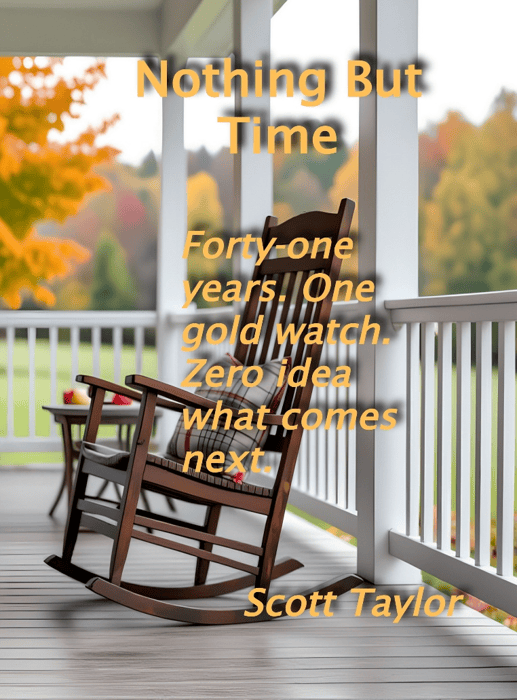
He spent his whole life working. Now he has nothing but time.
Jack Harper was the most dedicated employee his company ever had. Forty-one years without missing a deadline. Forty-one years without truly living.
When a forced retirement leaves him lost in the silence of his empty apartment, a letter from beyond the grave changes everything. His oldest friend, Ed, has died and left Jack a farmhouse in Vermont, along with a message he can no longer ignore:
“You’ve spent your whole life working. Now, it’s time to actually live.”
But the farmhouse holds more than memories. An antique radio plays songs from decades past. Fireflies rise from the grass like childhood returning. And sometimes, in the golden light of sunset, Jack sees Ed standing at the edge of the overgrown rose garden, waiting. Can a man learn to live when he’s spent a lifetime forgetting how?

You must be logged in to post a comment.