Tag: short-story

The Eyes That Held Starlight

The Eyes That Held Starlight

A Tale of Moonflowers and Magic


The autumn market was closing, its last lanterns breathing embers into the violet dusk, when Thomas first saw her.She stood behind a stall of dried herbs, strange glass vials, and most curiously, a single potted flower with tightly furled white petals that seemed to pulse with an inner glow . Her dark hair cascaded over a cloak the color of midnight, and the shadows pooled at her feet like devoted creatures, swaying when she did not move. The other vendors avoided her corner, whispering words like hex and cursed, but Thomas had never been one to heed whispers.

“You’re staring,” she said without looking up, her fingers sorting bundles of lavender. The dried flowers seemed to bloom again beneath her touch, their brittle gray stalks flushing with impossible color .

“Forgive me.” He stepped closer, his eyes drawn to the mysterious flower on her table.

“I’ve never seen anyone so…”

“Dangerous?”

A smile tugged at her lips.

“Lonely.”

The word hung between them, and for a moment, the wind itself paused to listen . As if in response, the white flower on her stall began to stir, its petals unfurling ever so slightly, though the sun had not yet fully set.Her hands stilled. For the first time, she lifted her gaze to meet his.Her eyes were the color of amber holding ancient insects, of honey left too long in the sun ; and Thomas felt, with sudden certainty, that she had looked at him this way before, not yesterday, not in any life he could name, but somewhere, in a time that existed only in the margins of dreaming.

“The moonflower,” she breathed, glancing at the plant in wonder. “It only opens for those whose hearts carry magic. It has never bloomed for a stranger before.”

“You should go,” she added softly. The lavender in her hands had wilted again, its petals curling inward like small fists . “Men who see loneliness instead of danger rarely survive the difference.”I know you, he thought, though he did not speak it aloud. I have always known you.

But the moonflower continued its impossible unfurling, releasing a perfume like silver and starlight and forgotten promises. Its luminous petals reached toward Thomas as though greeting an old friend.Thomas did not step back.”Perhaps,” he said, “I’m not interested in surviving.”

Something flickered behind her amber gaze…a light that did not belong to the lanterns, a light, he would later realize, that did not belong to this world at all .She laughed, quiet and unwilling, and the sound tasted of rain.


Thomas had expected darkness when he looked deeper into her eyes.He found instead an impossible cosmos: her irises swirled with flecks of gold and violet, like nebulae being born in the depths of her gaze. He saw the slow wheeling of constellations that had no names, the birth and death of stars compressed into the space of a heartbeat .The world around him dissolved.He felt the hum of the earth beneath his feet, a vibration older than language. He heard the silent song of the wind, a melody that had been playing since the first breath of creation. He sensed the threads of energy connecting every living thing, and woven through it all, he saw them: moonflowers, thousands upon thousands, blooming across the world in secret gardens and forgotten groves, their white petals opening like prayers to the night sky, each one a vessel of pure, ancient magic.When he finally blinked, the market had returned. But something had shifted. In his chest, where his heart had once beat in simple rhythm, there now thrummed a second pulse, faint, foreign, and unmistakably hers .”What… what was that?”

“Magic,” she whispered, and the word left her lips like a living thing . The moonflower on her stall had now bloomed fully, its petals impossibly bright in the gathering darkness. “But it shouldn’t be possible. Only those with the gift can see it reflected back.”

“I don’t have any gift.”Even as he spoke, Thomas felt the lie of it. That second pulse in his chest beat stronger now, syncing with hers in a rhythm that predated time itself .She reached out, her fingers brushing his cheek, warm, trembling, carrying the static charge of a thousand unspoken words.

Where her skin met his, he felt something unfurl inside him: a door opening onto a room he had never known existed .”Perhaps you didn’t,” she said. “Until now.”She pressed the moonflower into his hands. Its petals were cool as moonlight against his palms, and where he held it, the glow intensified…two magics recognizing each other at last.Above them, unnoticed by the departing merchants, a single star blinked into existence in the still-violet sky…newborn, impossible, and burning only for them .


They met every evening after that, in a secret grove where moonflowers grew wild, their luminous blooms turning the forest floor into a sea of living starlight.Elara, for that was her name, she finally confessed, a name that meant “shining light”…taught him to listen to the language of flames .

She taught him to coax flowers into bloom with a thought, though his first attempts produced only roses that wept silver and daisies that opened their petals at midnight, confused and luminous .But what Thomas treasured most were the quiet moments: her laughter when he failed spectacularly, the way she leaned into him when the night grew cold, as though his warmth were the only magic she had ever truly needed.

“The moonflowers,” she told him one night, as they lay among the glowing blooms, “they only grow where true love has touched the earth. That’s why people fear me…I tend gardens that remind them what they’ve lost. What they’ve never been brave enough to find.”She turned to face him, and he saw tears gleaming like captured moons in her amber eyes.”For so long, I thought I was meant to be alone. The keeper of magic no one wanted. The guardian of flowers that bloomed only in darkness.

“Thomas cupped her face in his hands. Around them, the moonflowers blazed brighter, responding to the emotion swelling between them.”They’ll never accept us,” she whispered. “A witch and the carpenter’s son .”Thomas took her hand. Where their fingers intertwined, small sparks drifted upward, lazy and golden, vanishing into the dark .”Then we’ll build our own world. Here, among your flowers. Where the only light we need blooms from the love we tend.”She turned to him, and in her eyes he saw not just magic now, but something far more powerful: hope .

“You saw me,” Elara whispered. Her voice trembled with the weight of years spent unseen. “When everyone else only saw something to fear, you saw me .”He kissed her beneath a canopy of moonflowers, and the magic between them needed no spell to ignite. Every bloom in the grove opened at once, releasing a perfume so sweet it would linger in that place for a hundred years. The grass beneath them bloomed out of season; the wind carried the scent of jasmine from a garden that existed only in memory .And the moonflowers…those faithful keepers of night and magic and impossible love, they whispered their blessing in a language only hearts could understand.


Some say love is its own kind of sorcery, the oldest and most unbreakable magic of all . And perhaps they are right.For in the years that followed, long after the village had crumbled to dust and the forest had swallowed the meadow whole, their story remained . It lived in every moonflower that dared to bloom, each white petal a love letter, each silver glow a promise that even the loneliest hearts, if they are brave enough to see past the danger, can find their way home to each other.And on quiet nights, when the moon hangs full and heavy, they say you can still find that grove, carpeted in eternal white blossoms, fragrant with magic, forever tended by two souls who proved that the deepest enchantment of all is simply this:To be truly seen.


The End

What did you think? I’d love to hear your thoughts in the comments below! Did this story make your heart flutter? Bring a tear to your eye? Remind you of someone special? Let’s chat about it. I read every single comment and truly treasure your reflections. 💬And if this little story touched your soul, please share it with someone who could use a dose of love today. Maybe it’s a friend going through a tough time who needs a gentle pick-me-up. Perhaps it’s someone whose heart is healing and could use a reminder that romance still exists in this world. Or maybe it’s simply someone who deserves to smile today.Stories like this are meant to be passed along, like love notes tucked into unexpected places.Share it. Spread the warmth. Let’s remind each other that tenderness still matters. 💕Until next time, keep believing in love…the quiet kind, the bold kind, and everything in between.

My Author Page

The Woman Who Learned to Listen

The Woman Who Learned to Listen

Elena had forgotten the sound of her own breathing. Forty-seven years of city noise, deadlines, and the electric hum of fluorescent lights had buried it somewhere beneath layers of static, pressed into that velvet darkness where forgotten things take root and wait.

So when her doctor (a soft-spoken woman whose silver-threaded hair caught light that wasn’t there, holding it like small, patient ghosts) told her to “find stillness,” Elena drove until the road turned to gravel and the gravel turned to sand.

The highway signs began to lose their letters somewhere past the third town, words slipping away like names from an aging tongue. She did not find this strange. The sand, when she finally stopped, hummed a frequency just beneath hearing, a sound her lungs seemed to recognize before she did. When she inhaled, truly inhaled, the breath tasted of salt and years, and something inside her chest unfolded like a letter she had written to herself long ago and never sent.

The beach was unremarkable at first glance. Gray-blue water. Foam curling like lace against the shore.

A weathered wooden bench that seemed to have grown from the dunes rather than been placed there; its grain twisted in the same spirals as the seagrass, its wood soft and salt-worn, remembering tides it had no business knowing.


She sat.


For the first hour, nothing happened. Her mind churned with grocery lists and unanswered emails, those small tyrannies of the living. But as the sun dipped lower, painting the clouds in shades of apricot and rose, Elena noticed something peculiar.


The waves were speaking.

Not in words, exactly, but in rhythm; a language older than syllables, older than the naming of things. And stranger still, she understood them. Each wave that kissed the shore carried a message: Let go. Let go. Let go. The words arrived not through her ears but through her sternum, settling into her ribs like birds returning to a familiar roost.


She laughed, thinking herself foolish.

But then she saw the herons. Three of them stood in the shallows, perfectly still, their reflections unbroken on the water’s surface (as if the sea had chosen, just for them, to hold its breath). And as Elena watched, they turned their long necks toward her in unison, not with curiosity, but with recognition, as though they had been waiting for her all along, as though her name had been written in the tide charts for forty-seven years.

Over the following days, Elena returned to the bench. She learned that if she sat quietly enough, the sea would show her things. Memories rose from the water like mist: her grandmother’s hands kneading bread (flour dusting the air like small, edible stars), her daughter’s first steps, a summer evening when she’d felt, for one perfect moment, completely whole. These visions arrived without explanation, and Elena did not ask for one. The sea gave what it chose to give.

The tide pulled her grief out gently, grain by grain, carrying it past the breakwater to wherever sorrow goes when it is finally ready to leave.

One morning, an old man appeared beside her. His skin was weathered like driftwood, and his eyes held the silver of deep water; not the color of it, but its weight, its patience, its memory of every drowned thing it had ever cradled. He smelled of salt and woodsmoke and something older, something before.

“You’re learning,” he said.

“Learning what?”

He smiled and gestured toward the endless horizon, where the sky stitched itself to the sea with threads of light. “That peace isn’t something you find. It’s something you become when you stop running from the silence.”

When Elena turned to respond, he was gone. In his place, a single white feather rested on the bench, still warm, as though it had only just remembered how to be still.

She never told anyone about the speaking waves or the herons or the old man who might have been the sea itself wearing a human shape, trying on bones and breath the way one tries on an old coat. Some truths aren’t meant for telling; only for carrying, quietly, like a stone smoothed by centuries of water. They live best in the body’s hidden rooms, in the spaces between heartbeats where language has no jurisdiction.


But her daughter noticed the change.


“You breathe differently now,” she said one evening, her voice soft with something close to wonder. “Like you finally have enough air.”


Elena smiled and thought of the ocean, still murmuring its ancient lullaby miles away, singing her name in a voice made of foam and forgetting.

She thought of the bench that grew from the dunes, the feather she still kept in her pocket (warm, always warm, as though it remembered flight). She thought of how silence, when you stop fearing it, becomes a kind of homecoming.

Somewhere, past the city lights and the hum of a world that never rests, the tide was turning. And deep in her chest, where her breath had finally learned to settle, Elena felt the waves answer.


Let go. Let go. Let go.


She had. And in the letting go, she had, at last, arrived.

When clickbait and other forms of noise enter your life, remember this story. The clamor of the city does not stop at your front door; it slips through your screens like water through cracks, hums from the radio in frequencies designed to unsettle, and arrives even through friends who carry their own static, their own buried breath, their own need to hear what the waves have always been saying.


Fear and anxiety are not merely emotions. They are small, patient thieves. They breed toxins in the marrow, shorten the years the body was promised, and fill the spaces where stillness ought to live with a noise that masquerades as urgency.


But somewhere, there is a bench growing from the dunes. Somewhere, herons stand in the shallows, waiting with recognition in their ancient eyes. Somewhere, the tide is turning, ready to carry your grief out past the breakwater, grain by grain, to wherever sorrow goes when it is finally ready to leave.


Sit by the ocean (or by whatever ocean you can find; silence wears many shapes). Listen for the rhythm older than syllables.


And let it go.


Let it go.


Let it go.


—Scott

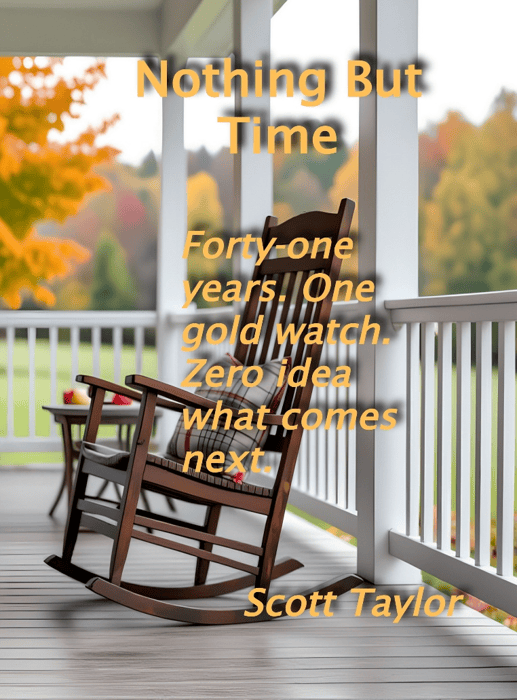
He spent his whole life working. Now he has nothing but time.

Jack Harper was the most dedicated employee his company ever had. Forty-one years without missing a deadline. Forty-one years without truly living.

When a forced retirement leaves him lost in the silence of his empty apartment, a letter from beyond the grave changes everything. His oldest friend, Ed, has died and left Jack a farmhouse in Vermont, along with a message he can no longer ignore:

“You’ve spent your whole life working. Now, it’s time to actually live.”

But the farmhouse holds more than memories. An antique radio plays songs from decades past. Fireflies rise from the grass like childhood returning. And sometimes, in the golden light of sunset, Jack sees Ed standing at the edge of the overgrown rose garden, waiting. Can a man learn to live when he’s spent a lifetime forgetting how?

Ellie Morrow: A Tale of Grief and Magic

Ellie Morrow: A Tale of Grief and Magic

Ellie Morrow has spent six years in the foster care system learning one lesson above all others: she breaks things.

Televisions implode when she’s angry. Pipes rupture when she dreams. Crows gather wherever she goes—silent, watchful—as though waiting for a signal only they can hear. And deep behind her sternum, something that is not quite a heartbeat pulses with a power she never asked for: a residual fire left over from the night a mysterious golden light filled her parents’ car on Route 9, killed everyone inside except her, and left a seven-year-old child without a scratch or an explanation.

“You are not broken, Ellie. You are not dangerous. And you are not disposable.”

But the foster care system disagrees. And so, when an estranged grandmother named Agatha Morrow arrives to claim her—a woman who chose thirty years of silence over the burden of explanation—Ellie is pulled from the only world she has ever known into something older and stranger: the breathing, sentient world of the Morrow women. A bloodline of immense power stretching back centuries. A house on a nameless mountain, built above a nexus of forces older than language. A legacy of magic and grief, of doors that should not be opened and things that sleep beneath foundations, of wards that answer to family and a home that has been waiting for the right Morrow to return.But Ellie is not merely inheriting power. She is awakening something. The blood moon is coming, and whatever has been dreaming in the deep places beneath the Morrow house—vast, impossibly old, and stirring for the first time in generations—has begun to rise, drawn upward by a girl whose emotions can crack buildings and whose light can fill a room with the color of old gold.

Part coming-of-age story, part Gothic supernatural mystery, and part meditation on grief, survival, and the terrible weight of belonging to something larger than yourself, the Girl Who . . . series asks one question and dares its heroine to answer it:

Get your copy here…

Where they are
Unraveling Family Secrets: My Journey with Amelia Earhart

Unraveling Family Secrets: My Journey with Amelia Earhart

A few weeks ago, I shared this story on the Reedsy website as part of a contest—one that feels just about as realistic as actually locating my distant cousin, Amelia Earhart. However, today I wanted to share it with you, my audience. Maybe it’ll brighten your day or spark a little curiosity about the connections we all might share, even on this very site.

You see, we all hear stories about our relatives from eons ago, whispers passed down through generations, fragments of lives that shaped who we are. For me, those whispers were irresistible. As a writer, I had to know the truth, no matter who my ancestors turned out to be. Even if they were mafia bosses or obscure nobodies, I knew there would be tales worth telling.

So, I did the DNA thing. I poured time, energy, and more money than I’d like to admit into genealogy research. And what I unraveled was a tapestry of intrigue that stretched far beyond what I ever expected.

My childhood was a kingdom built on whispers, stories of valor, tradition, royalty, and scandal that seemed to weave themselves into the very air I breathed. A haze of cigar smoke clung to the image of a defiant political figure, while hushed voices hinted at royal blood flowing through my veins. And always, in the background, there was a shadow—a darker figure, the man who erased eighteen minutes of history in Washington.

These weren’t just stories. They were my inheritance. Power. Secrets. A kaleidoscope of intrigue buried deep in my DNA.

When I finally cracked open the past, these stories took on new life. The more I dug, the more I found royalty, scandal, and power. And then, Amelia Earhart. A name that needs no introduction. A name that leapt off the pages of history and into my family tree.

A distant cousin. A bold trailblazer. A perfect metaphor for navigating uncharted waters or even waiting to be rescued.

But this isn’t just a story about her disappearance. It’s about the echoes she left behind, the way her legacy is stitched into the fabric of history—and, somehow, into me.

So here’s to the past, to the stories we inherit, and to the ones waiting to be uncovered. Sometimes, they lead to royalty. Sometimes, to scandal. And sometimes, to Amelia Earhart.

***

Sunlight blazed on the Papua New Guinea airstrip. Heat waves distorted the cracked earth. Morning light reflected off the hangars. Only faint insect hums and distant tools broke the silence.

Amelia Earhart stood by her Lockheed Electra, calm but tense. Her tapping foot betrayed her unease. The Electra sat ready in the sun, engines primed. Dressed in khaki slacks and a white blouse, her sharp gaze cut through the moment. Waiting wasn’t her strength.

Noonan was late.

Her sigh cut through the silence. Frustration burned in her chest, but beneath it churned something colder: anxiety. A storm of nerves tightened her gut. Ahead of them stretched 2,556 miles of ruthless ocean, no markers, no mercy. Just an endless expanse of restless blue. Howland Island? A speck on the map. Miss it, and they were nothing but ghosts swallowed by the sea.

She turned the thought over in her mind, locking it away behind a mask of calm. This leg was different. She felt it in her bones, and Fred did too, though he hadn’t dared say it out loud. He didn’t have to. The radio was dying, had been for days. Their antenna? A jury-rigged prayer held together by wire and hope. Every burst of static from the speaker stabbed like a cruel reminder: their mission was a house of cards, teetering in the wind.

A breeze stirred, carrying the damp tang of jungle earth. Amelia closed her eyes, letting it brush against her, grounding her. She thought of George, waiting for her back home. The reporters, waiting to write her triumph or her obituary. And the little girls, faces she’d never seen, who dreamed of reaching the sky because she’d dared to take it. Their dreams hung on her wings, and the weight of it all pressed down on her like lead.

Footsteps broke through the humid stillness.

She opened her eyes. Fred was striding toward her, untucked and unshaven, his hair a wild mess. That grin was back, the cocky, boyish grin he always wore, like danger was something he could charm away. Like the ocean wasn’t out there, waiting to swallow them whole.

“You’re late,” Amelia said, her voice slicing through the thick air like a propeller blade.

He strolled toward her, his untucked shirt flapping lazily in the breeze, that cocky, devil-may-care grin plastered across his face. “Morning, boss,” he drawled, like they were gearing up for a casual Sunday jaunt instead of staring down the most perilous stretch of their lives.

“Fred,” she said, her voice low and edged with steel, “this isn’t just another leg of the journey.”

“I get it, Amelia. I do.”

She gave a single, sharp nod. “Let’s go,” she said.

Without waiting for a reply, Amelia spun on her heel and strode toward the Electra. Behind her, Fred fell in line, tugging his shirt straight and rolling his shoulders back, as if shaking off the weight of what lay ahead. The plane loomed in the distance, its silver body catching the light.

They were all set. Or as prepared as anyone could possibly be for this.

The engines roared to life, a symphony of power and defiance, drowning out words, fears, and second thoughts.

Hours into the flight, the sky burned with the last light of the setting sun, the horizon splitting into gold and crimson hues. In the cockpit, Fred studied the stars, his hands steady, his mind focused. The constellations were their map, their lifeline in the endless blue expanse.

The stars wouldn’t wait forever. Clouds crept across the sky, swallowing their guides one by one. If Fred hadn’t overslept, they’d be closer to safety by now, before the night went blind.

The overcast wasn’t just inconvenient; it was catastrophic. The stars, his lifeline, vanished behind an impenetrable shroud.

“Have you heard from the Itasca?” he asked.

“No,” Amelia said flatly. “I’ve announced our position. No response.”

Fred cursed, the broken antenna flashing in his mind. Who could they even reach out here?

“Can we climb above the clouds?” he shouted.

“We’re burning too much fuel,” she replied.

Fred slumped. No stars. No antenna. Radio silence. A storm churned ahead. Below: endless sea. All they had was the compass, and luck.

Rain hammered the windshield, the storm howling against the Electra’s fragile frame. Lightning tore jagged scars through the darkness. Inside the cockpit, there was no horizon, no bearings, only chaos.

“Fred, give me a heading!” Amelia yelled above the engine noise. “What is our location?”

Fred’s hands trembled as he wrestled with the compass. “I’m trying! The storm’s throwing it off, it’s spinning!”

The Electra shuddered, caught in the storm’s grip, as the ocean below waited, silent and merciless.

“We’ve been on this heading for three, maybe four hours,” Fred shouted, flipping through his maps. “If there’s a headwind, we’re burning more fuel than we thought. We should be near Howland by now.”

“‘Should be’?” Amelia snapped, her voice cutting like the storm outside. “Great. I’ll just ask the ocean to wait while we figure it out!”

Fred’s voice cracked. “I don’t know what to tell you! Without the stars, I’m flying blind! The compass is all we’ve got, and with this storm, it’s probably off!”

That was not the answer she was looking for. Without her instruments, she would most certainly crash them into the ocean. She couldn’t tell where the sky stopped, and the sea began.

Fred froze, pale and silent. The storm battered the plane, each gust shaking the Electra to its core. The fuel gauges ticked lower, the needles creeping toward empty.

Rain blurred the windshield, the instruments glowing faintly in the chaos. Lightning slashed through the black void, illuminating the endless Pacific below.

“I… I didn’t think it’d be this bad,” Fred muttered, his voice breaking. “I thought…”

Amelia cut him off, her words sharp as steel. “You thought what, Fred? That the Pacific would be kind? That we didn’t need the antenna. That we could just point the nose east and hope for the best?”

The plane lurched violently, throwing them forward. Amelia gritted her teeth, fighting the controls as the Electra groaned under the storm’s fury. For a moment, neither spoke. The pounding rain and roaring engines filled the silence.

She exhaled sharply, frustration hardening into focus. When she spoke again, her voice softened, though the fear lingered beneath.

“If the compass is all we’ve got, we use it, imperfect or not. We keep on this heading until we succeed or we go swimming.”

Fred nodded, his breath unsteady as he forced himself to focus. “You’re right. Okay. I’ll keep us on this heading. I’ll recheck the drift estimates and adjust for the wind. We’ll figure this out.”

Amelia’s eyes stayed locked on the storm ahead, her jaw tight. “We don’t have much time to figure anything out. The fuel’s going faster than it should. This headwind’s killing us.”

Fred hesitated, his voice catching. “How much flying time do we have left?”

“Three hours. Four, if we’re lucky.” Her voice was flat, her expression unyielding. “But luck’s not exactly on our side, is it?”

Fred dropped his gaze to the maps in his lap, his voice barely a whisper. “No. It’s not.”

Lightning flashed, flooding the cockpit with white-hot light. Fred’s face was pale, every tight line around his eyes carved with worry. Amelia’s grip on the yoke tightened, her knuckles bone-white. The plane shuddered again, the storm clawing at their fragile craft.

Fred tried to summon hope. “Maybe it’ll clear. Maybe the clouds will break, and I can get a fix on the stars.”

He stared at his maps, his voice barely above a whisper. “I’m sorry, Amelia. I should’ve fixed the antenna better. I should’ve been ready for this.”

His trembling hands adjusted the compass, eyes locked on the erratic needle jerking under the storm’s interference.

The engines droned unevenly, straining against the wind and rain. Somewhere out there was Howland. Their only option was to continue, slowly advancing as the immense Pacific stretched out beneath them.

The storm eased, just enough to reveal patches of rippling black ocean, infinite and indifferent. The Electra cruised low at 1,000 feet, its fuel gauges hovering dangerously near empty. Amelia’s face was set, her jaw locked. Fred sat in silence, ashen, gripping his map and compass as if they were the only things tethering him to hope.

Amelia shouted over the engines. “I’m calling the Itasca! Maybe they’ll hear us!”

“Itasca, this is Earhart. One thousand feet. Heading east. Position unknown. Low on fuel. Repeat, low on fuel. We estimate we’re near Howland Island. If you can hear us, we need assistance. Over.”

Amelia released the mic. The cockpit filled with an empty, mocking hiss.

Fred leaned forward, his voice barely a whisper. “Come on… please…”

Nothing. Just the relentless crackle of silence.

Amelia tried again. “Itasca, this is Earhart! Do you copy? We’re out of time! Over!”

The reply was the same.

Fred slammed his fist against the armrest, his frustration seething. “Damn it! They can’t hear us.”

The engines groaned as the storm eased, revealing only the vast, empty Pacific below. The fuel gauges hovered dangerously close to empty.

“We’re at our limit,” Amelia said softly, her voice calm but heavy. “These engines won’t last.”

Fred leaned forward. “Drop lower! We might see something, land, anything!”

Amelia hesitated, then tightened her grip on the yoke. “Fine. Hold on.”

The Electra dipped, skimming just above the waves. The engines strained as Fred pressed his face to the window, scanning the endless horizon.

“Wait!” he shouted, pointing frantically. “There! Off the left wing—do you see it?!”

Amelia squinted, her heart pounding. Then she saw it—a faint outline, waves breaking against something solid.

“An island,” Fred gasped. “That has to be it. Howland, or something close!”

Amelia’s voice stayed grim. “We get one shot. If we miss, we’re done.”

The fuel needle dropped to empty. She clenched her teeth, aligning the plane with the distant shadow.

“Steady,” she murmured.

Fred’s voice cracked. “What if it’s just a reef? Can we even land there?”

“Fred!” she barked. “Shut up and let me fly!”

The engines sputtered. One died. The propeller slowed, then stopped, and the Electra lurched violently. Amelia wrestled the controls, leveling the plane as the second engine coughed its final breath.

“Get ready!” she shouted, her voice echoing through the air. “If it’s not land, we’re going to have to start swimming!”

With a shudder, the second engine failed. The silence was overwhelming, with the only disruption coming from the wind’s fierce howl against the plane. The plane glided toward the surf, a fragile machine against the roar of the ocean.

“Come on,” Amelia whispered. “Just a little further…”

The plane skimmed the waves, the salt spray misting the windows, then slammed into the shore, a mix of sand and unforgiving rock. A flicker of hope ignited in that instant.

“Amelia!” Fred screamed. “Watch out!”

The plane jolted violently, slamming into jagged rocks. Water sprayed on either side as the Electra skidded to a halt, its crushed nose buried in sand.

Silence. No engines. No voices. Only the crash of distant waves and the groan of the battered fuselage settling into the earth.

The sudden stop from the harness’s grip on the seat stole her breath. Frozen, she sat, the ragged sound of her breath echoing in the silence. “Fred… you okay?” she rasped, the sound thin and frail.

The Electra lay in a shallow lagoon, its crumpled nose half-buried in sand and rock. Tidewater lapped at its sides, creeping into the fuselage. Overhead, the storm had broken, clouds parting to reveal faint moonlight on a desolate beach.

Inside the cockpit, they worked quickly, soaked and shaking.

Her wet gloves slipped against the straps, her arms screaming with fatigue, but she didn’t stop. Finally, the emergency radio came free. “Got it. Help me with the power unit.”

Fred staggered back, panting. “This thing weighs a ton. If the tide comes in faster…”

“We’ll make it,” Amelia declared, her voice echoing with a steely determination. “Keep moving.”

They climbed off the wing, plunging waist-deep into the frigid water. The cold sliced through their soaked clothes, stealing their breath, but they pressed on. The lagoon reeked of salt and damp earth, the steady crash of waves the only sound beyond their labored breaths.

Fred shivered, his voice thin. “Do you think anyone heard us? Before the engines died?”

Amelia didn’t look back; her gaze was locked ahead. “I don’t know. I hope so.”

Her voice was steady, but Fred caught the strain beneath it, the fear she buried under sheer determination. She gripped the radio tighter, the cold metal biting into her gloves.

The shore drew closer. Their boots sank into the shifting sand beneath the shallow water. The lagoon, now calm, mirrored the pale glow of the moon. Around them, debris, seaweed, driftwood, and jagged rocks littered the beach like the remains of a forgotten world.

Fred broke the silence. “God, it’s so quiet.”

“Quiet’s better than thunder,” Amelia replied. “Let’s get everything to higher ground before the tide takes it.”

They fell onto the sand, the power unit hitting with a thud. Amelia rolled her aching shoulders. Fred gasped, dropping to his knees, the flashlight shaking.

“Could this be Howland?” he asked.

Amelia scanned the dark horizon, hands braced on her knees. “Maybe. Or another island nearby. Hard to tell in the dark.”

Fred’s voice wavered. “And if it’s not? What if it’s just… nothing? An empty speck in the middle of nowhere?”

Amelia straightened, her tone steady. “Then we survive. One step at a time.”

Fred’s pale face was fixed on the lagoon as he nodded slowly. The wrecked Electra, a spectral outline, sat half-submerged, its broken form a chilling sight against the vast Pacific. Crushed by the vastness, he felt nothing but the weight of his isolation, with no rescue or certainty in sight. A wave of nausea caused his stomach to churn.

Amelia’s hand gripped his shoulder. “We’re not done yet,” she said, her voice resolute. “As long as we’re breathing, we’ve got a chance. Let’s get the radio set up.”

Each step was a struggle, their bodies stiff and heavy, yet necessity compelled them to move forward. As Amelia unpacked the radio, Fred dragged the power unit, its weight a heavy drag, near the tree line. Her numb fingers worked with painstaking slowness. The night buzzed around them, a symphony of insect hums and rustling palms, each sound piercing the silent air.

Fred’s eyes darted nervously toward the deep, looming shadows. “Do you think anything could possibly be living in this quiet place?”

Amelia kept her gaze fixed downward. “Let’s not make that a priority for now.”

With meticulous movements, Amelia connected wires while Fred held the flashlight, the beam dancing nervously as he glanced at the shadowy tree line. The faint moonlight cast an ethereal glow, barely holding back the darkness of the night.

At last, Amelia straightened, wiping her hands on her damp trousers. She exhaled slowly, her breath visible in the cool air.

“That’s it,” she said, her voice quiet but firm. “Let’s see if anyone’s listening.”

The switch clicked. The radio crackled to life, a faint, fragile hum. Hope jolted through them.

As Amelia grabbed the mic, the weight of the situation made her voice both steady and urgent. “Mayday, mayday,” a frantic plea cut through the otherwise silent airwaves.

Endless static stretched, creating a suffocating pressure. Fred’s heart pounded in his chest as he held his breath.

Amelia tried again, her tone firmer. “Mayday, mayday. This is Amelia Earhart. Is anyone there? Over.”

The radio teased them with faint crackles, as if a voice hovered just out of reach. But no reply came.

Fred closed his eyes, shoulders sagging in quiet defeat. Amelia lowered the mic, her jaw tight, her eyes sharp.

“They’ll hear us eventually,” she murmured, almost to herself. “We just have to keep trying.”

For a moment, neither spoke. The weight of their reality pressed down, heavy as the humid air. The moon hung low, casting long shadows across the beach. In the distance, waves broke softly against the shore, a haunting rhythm in the stillness.

“Help me light a fire, Fred.”

Gathering driftwood, Fred finally broke the silence, his voice barely audible. “What if no one comes?”

She didn’t answer right away, her gaze fixed on the horizon. When she spoke, her voice was calm, resolute.

“Then we survive, one way or another, we survive.”

And that, my friends, is how I want to believe they slid into the history books, as survivors.

-Scott

Share the Journey

If this story resonated with you, I’d love for you to share it with others who might enjoy unraveling tales of history, mystery, and legacy. Give me a follow and stay tuned, there are more stories to come, and I can’t wait to share them with you.

If this is the kind of content you love, let me know in the comments! Your thoughts, connections, and stories mean the world to me, and I’d love to hear what you think.

Here’s to exploring the past, uncovering truth, and finding stories worth telling. Stay curious. 🌟

  • #GenealogyJourney
  • #FamilyHistory
  • #DNAStories
  • #AncestryResearch
  • #DiscoverYourRoots
  • #HiddenHeritage
  • #AmeliaEarhart
  • #AviationHistory
  • #Trailblazer
  • #PioneeringWomen
  • #FlightLegends
  • #AviationMystery
  • #WritersLife
  • #StorytellingMatters
  • #CreativeWriting
  • #HistoricalFiction
  • #WritingCommunity
  • #MysteryWriters
  • #UnravelingThePast
  • #AdventureAwaits
  • #MysteryAndLegacy
  • #HiddenStories
  • #ExploreHistory
  • #BeyondTheHorizon
  • #HistoryLovers
  • #WomenInHistory
  • #LegacyOfCourage
  • #InspiredByHistory
  • #HistoricFigures
  • #UnsolvedMysteries

Why I Value Critiques Over Prizes in Writing Contests

Why I Value Critiques Over Prizes in Writing Contests

This week’s entry…

Many of you know I frequently submit contest entries to Reedsy, aiming for several submissions each month.

While the tease, the carrot, if you will, of $250 is nice, the reality is that I don’t even consider that part of the prize that I am seeking.

People around the world read my stories. While a simple “like” is an affirmation in that they took the time to click like, it is for the critiques of other writers I seek.

Since they don’t know me, they can tell me what they honestly think or feel. I also reciprocate for the stories that I read. I do that with the good, the bad, and the ugly.

This week’s entry was posted, and I received the following review.

Scott, your story masterfully blends humor, serendipity, and heartfelt moments into a captivating narrative that made me feel like I was right there in the snowed-in airport. The line, “No, I’m not tired,” he whispered sadly, “but I’m also sad to see the blizzard ending,” encapsulates the bittersweet feeling of fleeting connections and new possibilities. Your depiction of Victor and Emma’s banter and chemistry, especially their shared frustrations and quick wit, is utterly delightful. The humor throughout the story—like Emma’s hilarious commentary on airport bars—kept the mood lively while the underlying emotions added depth. Your vivid descriptions, especially of the bustling airport bar and Victor’s nostalgia for Toad Suck, created a rich, immersive backdrop. This is a wonderfully crafted piece with humor, heart, and charm. Thank you for sharing such a delightful read!

I am not sharing this as a brag but as an example.

Countless similar contests, with their own unique rules and prizes, undoubtedly exist across various platforms and communities. For me, these contests are much like a recess from grade school—a welcome break from the pressures of work, a chance to let loose and have some fun, just like those carefree days of childhood. The prompt transports me from my project – be it the chilling winds and barren rocks of an alien planet or the plush carpets and rich scents of a movie star’s boudoir. The challenge is to meticulously plan my writing, unlike my spontaneous, free-flowing pantster style. With a maximum of 3000 words, creating the arc, the storyline, and so on is excellent practice for that New York Times bestseller that is looming in the near distance of my imagination.

Follow the link to my entry and see what you think. Was she right?

Recently, I published a book of these entries called Ephemera, Tales of the Fleeting and Profound. Another book with the same name, Vol II, is in the making as I take these stories, edit them, add to them as I see fit, and re-publish them as a book of short stories. You can find my work here.

Welcome to 2025 and your personal connection to someone passionate about the craft of writing.  Cheers!