Tag: poetry

Breaking Free from Echo Chambers

Breaking Free from Echo Chambers

Could you picture yourself as a Star-Bellied Sneetch, looking down your nose at those without stars? Or maybe a North-Going Zax, stubbornly stuck in your tracks, refusing to budge an inch? Many of you are and much like that ostrich, your head is in the sand.

What happens when we live in bubbles? We become so sure of our ways that we can’t even glance at another point of view. Let’s dive into a Seussian tale of echo chambers, silly spats, and the surprising magic of opening our minds!

The Tale of the Elephants and Donkeys

On a hill, not so far, and a valley nearby,

Lived Elephants grand and Donkeys spry.

They lived in their herds, apart and aloof,

Each sure that the other was silly—”Goof-proof!”

The Elephants trumpeted, “We know what’s best!

Our views are the finest, far above the rest!”

The Donkeys brayed back, “Oh, what a joke!

Your big stomping feet just kick up more smoke!”

From morning till night, they argued and bickered,

Each pointing out why the other was fickle.

“Your ideas are small!” “Your plans are absurd!”

But neither side listened—oh, not a word!

They sat in their chambers, their echo-filled halls,

With mirrors that hung on the thickest of walls.

The mirrors told tales they already believed,

And voices repeated what they’d always conceived.

“Those Donkeys are wrong!” “Those Elephants, too!”

“They’ll ruin the world with the things that they do!”

And so they stayed stuck, in their separate domains,

Each calling the other mean names and refrains.

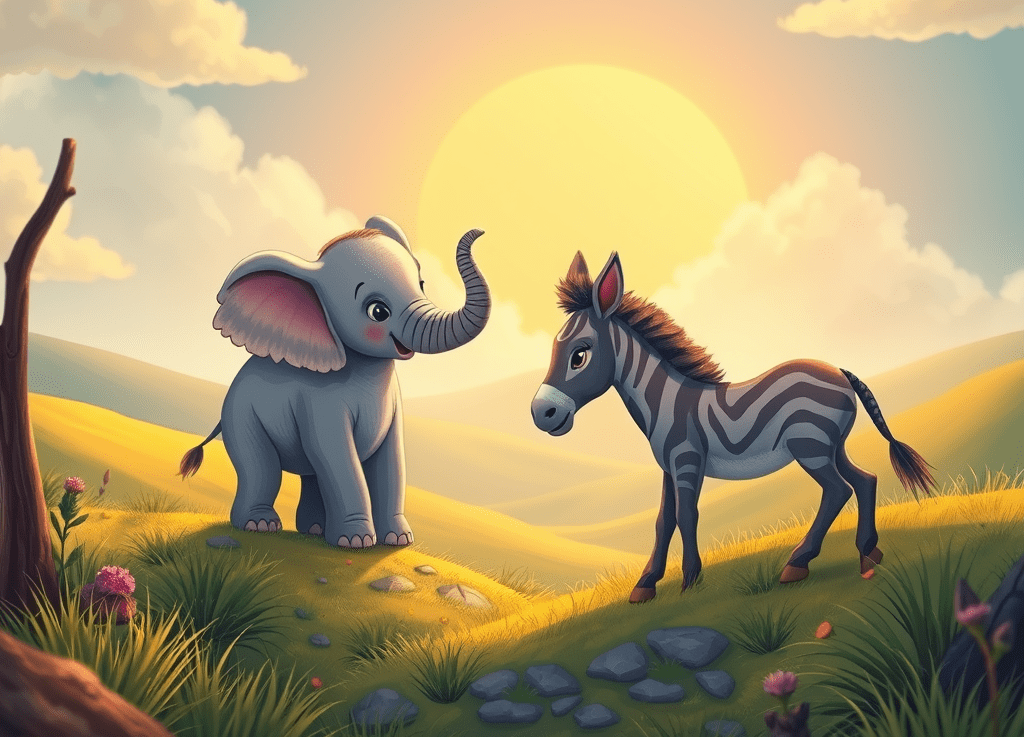
But one sunny day, a young calf and a foal,

Both curious creatures, with hearts that were whole,

Met on the path that split hill and the valley,

And decided to chat, take a walk, and to dally.

“Your ears are quite long!” said the calf with a grin.

“And your trunk is so strong!” said the foal, leaning in.

They laughed and they talked, they shared and they learned,

And found common ground where respect could be earned.

When they told their herds of the day they had shared,

The Elephants scoffed, and the Donkeys just stared.

“How could you listen? How could you see?

They’re so very wrong—they’re not like you and me!”

But the calf and the foal, undeterred by the chatter,

Said, “The world’s much too big for such silly clatter.

If we never look past our own little views,

We’ll miss all the colors, the reds, greens, and blues!”

And soon, one by one, others tried it as well,

And the chambers of echoes began to dispel.

The Elephants listened, the Donkeys did too,

And they learned there were more than just red and blue.

So remember this tale, of the calf and the foal,

Who broke through the walls and found something whole.

The world’s much too grand to stay stuck in one view,

So open your mind—and see something new!

Echoes of Silence

I have friends, once dear, now distant and cold,

For they believe my heart does not uphold

The banner they wave, the creed they proclaim,

And in their silence, they utter my blame.

Yet they assume, for I do not cry aloud,

Nor join the fray of the thundering crowd.

Hot topics rage, the media’s snare,

Dividing souls with cunning flair.

Oh, traveler, pause in the bustling air,

Look to the screens that flicker there.

Each tuned to a single, unyielding refrain,

For gold, not truth, does the channel sustain.

Orwell foresaw, with prophetic sight,

The shadowy hand that twists the light.

At the BBC, he learned the tale,

Of how the press can deceive and prevail.

Yet still, a whisper, a hope remains,

Though shackled minds wear heavy chains.

“The truth shall set you free,” it’s said,

Though lies may linger, and trust lies dead.

Take heart, dear soul, and heed this plea:

“Illigitimi non carborundum”—stay free.

For in the battle of thought and pen,

Courage shall guide both women and men.

And Finally…

No Toes McGrew

If rage should rise at whispers from the press,

Beware, for thou art caught in their caress.

A siren’s song, it lures thee to the fray,

To blind thy reason, steal thy peace away.

They sow division, conquer with their art,

And plant their thorns within the tender heart.

Oh, pause, dear soul, and see their cunning guise,

The painted veil that clouds thy seeking eyes.

Wise up! For folly waits with bated breath,

To guide thee down the thorny path to death.

Lest thou become, like poor McGrew of lore,

Who cried, “Ready, fire, aim!”—then was no more.

Hi everyone,

I wanted to take a moment to share a little update on where I am and what I’m working on. First off, if you’ve been enjoying my attempts at poetry, please let me know—I’d love to hear your thoughts! Poetry isn’t exactly my forte, but it’s been a fun and meaningful way to express myself lately.

As for my writing, The Big Beautiful Book of Stupid Shit is now marinating in the creative process. While that simmers, I’ve turned my attention back to a project I started five years ago—a book about magick. Now seems like a perfect time to revisit it. I’ve been needing an escape from the chaos and negativity that surrounds us.

To be honest, I’ve been feeling overwhelmed by the constant noise. It is the news, social media, or conversations. These conversations seem to divide us more than bring us together. I know I’m not alone in this. Still, sometimes it feels like the world is full of people suffering from, well… let’s call it “rectal cranial inversion.” It’s exhausting. Stepping away from the animus that seems to pervade everything has been a necessary breath of fresh air for me.

If you’ve ever felt the same way, you’re not alone. Sometimes we need to unplug, refocus, and channel our energy into creating something meaningful rather than engaging with negativity. I’m trying to find joy in the creative process. I want to remind myself why I love connecting with all of you.

Thank you for sticking with me, for supporting my work, and for being part of this journey. I truly appreciate you, and I’m excited to share more with you all soon.

Scott

Mastering Syllable-to-Word Ratio for Better Writing

Mastering Syllable-to-Word Ratio for Better Writing

Have you ever come across one of those carts parked outside a half-price bookstore, overflowing with books so cheap that even the employees inside wouldn’t bat an eye if you walked off with one? Yeah, those. The literary graveyard of rejected paperbacks and forgotten hardcovers. I’m a sucker for them. I’ll sift through the pile, find something that piques my interest, and then march inside like a responsible adult to actually pay for it.

But here’s the thing: you ever wonder why those books ended up in the discount bin of shame? Nine times out of ten, it’s the writing. Oh boy, the writing. Either it’s drowning in purple prose, or the author decided, “Hey, let’s crank this up to a college-reading level and see how many people’s brains explode.”

Target Audience Problems: A Writer’s Existential Crisis

In creative writing, we’re always told to think about our target audience. Sounds simple, right? Wrong. Here’s where it gets messy. Imagine this: someone brings their masterpiece to a critique group. It’s a highbrow novel meant for intellectual types who sip chai tea and quote obscure philosophers. But the group? They hate it. They can’t explain why, but they just don’t. The writer spirals into a pit of frustration, and the critique group sits there awkwardly like, “Sorry, we don’t know what’s wrong, but it makes our brains hurt.”

Let me save you the trouble. It’s probably the syllable-to-word ratio. Yeah, I know, sounds nerdy, but stay with me.

What the Hell is Syllable-to-Word Ratio?

I’m glad you asked (or at least pretended to). The syllable-to-word ratio is this super-geeky metric that measures the average number of syllables per word in a chunk of text. Why should you care? Because it can make or break how your writing feels to your reader.

Here’s the gist:

Readability:

Low ratio (1.2–1.4): Short words, easy to read. Think, “See Spot run.”

High ratio (1.5–1.8+): Long, complex words that scream, “I have a Thesaurus and I’m not afraid to use it!”

Pacing and Flow:

Lower ratios = faster pace. Great for action scenes or snappy dialogue.

Higher ratios = slower, more reflective. Perfect for moody, poetic, or “I’m trying to win a Pulitzer” moments.

Style and Tone:

Writing a child’s perspective? Keep the words short and sweet.

Got a pretentious professor as your main character? Break out the big words and make them earn that Ph.D.

Let’s Look at Some Examples

Here’s a basic breakdown to show you the difference:

Paragraph 1 (Simple Language):

The cat sat on the mat. It looked at the sun and purred.

Words: 14

Syllables: 16

Ratio: 16 / 14 ≈ 1.14

Paragraph 2 (Complex Language):

The magnificent feline reclined gracefully upon the embroidered carpet, basking serenely in the golden illumination streaming through the window.

Words: 20

Syllables: 38

Ratio: 38 / 20 = 1.9

See the difference? The first paragraph is quick, punchy, and gets straight to the point. The second one? It’s like the writer wanted you to pause dramatically after every word and think about life’s meaning.

Why This Matters in Creative Writing

Knowing your syllable-to-word ratio isn’t just some geeky flex. It’s a tool. A sneaky little trick to control how your readers experience your writing. Here’s how you can use it:

Want to speed things up during an action scene? Keep the sentences short and the words even shorter.

Need to slow things down for an emotional moment? Stretch it out with longer words and more complex sentences.

Writing dialogue? Match the ratio to your character’s personality. A street-smart detective won’t talk like a philosophy professor (unless that’s part of the joke).

Tools to Make Your Life Easier

Let’s be real, no one’s doing this math by hand. Use an online syllable counter or plug your text into something like Hemingway Editor. These tools will tell you if your writing is too complex or if you’re on track for that sweet spot of readability.

Final Thoughts: The Ratio is a Jedi Mind Trick

The syllable-to-word ratio is one of those sneaky things that can make your writing flow better, feel more immersive, and keep readers glued to the page. It’s not about dumbing down your work; it’s about making sure your readers don’t feel like they need a dictionary just to keep up. Trust me, I’ve been there. When I first started writing, I thought flexing my vocabulary was the key to literary greatness. Spoiler alert: it wasn’t. People don’t want to stop every other sentence to Google a word. They want to stay in the story.

So, play around with it. Experiment. Try writing the same scene with different ratios and see what feels right. And for the love of all that’s holy, don’t be afraid to use simple words. Sometimes, “The cat sat on the mat” says everything you need it to.

Share the Wisdom, Spread the Love

These writing tips don’t write themselves… Yes, I care about writers, but let’s face it, I am an author and my books need a little marketing. So…

If this was helpful, share it with your writer buddies. One share is like sending a virtual high-five to both me and them. And who doesn’t love a good high-five?

Until next time, happy writing, and remember, fewer syllables can sometimes make for a hell of a better story.

  • #ContentCreation
  • #StorytellingTips
  • #ContentWriters
  • #WriterGoals
  • #FictionWriting
  • #HowToWrite

A Tribute to Miss Thunberg. Apprehended in the pursuit of different windmills.  

A Tribute to Miss Thunberg. Apprehended in the pursuit of different windmills.  


In search of monsters…

In an age where the winds of change blew with an unwavering fervor,

A young and determined damsel lived, her spirit as unyielding as steel.

With locks shining like the sun’s golden rays and eyes as deep and endless as the sea.

Setting sail upon the azure waves, she felt the salty mist on her face, her spirit ignited with a courageous mission.

“Forsooth!” she cried, her voice echoing through the air with a clarity that couldn’t be ignored.

“I long for the passion of protest, where voices crescendo, and hearts ignite with purpose.

At the point where the ocean meets the sky, the seagulls soar freely.

I shall find my brethren in arms, their resolute voices echoing in the air.”

Her sturdy galleon gracefully glided across the sparkling brine.

As she searched for the clarion call, her ears strained to catch even the faintest whisper of the divine.

Through raging storms and tranquil seas, she sailed tirelessly day and night.

In relentless pursuit of a cause most just, they were determined to face whatever challenges lay ahead.

And behold! Where the sea and future intertwine on the horizon, a gentle breeze carried the scent of salt and adventure.

Her eyes caught sight of a defiant throng, united in their unwavering resolve.

With banners held high and stanch spirits, they defiantly stood their ground against the relentless tide.

And with open arms, they warmly embraced her, inviting her to stand by their side.

Once a sailor of the vast ocean, the young lady now found herself amidst the honking horns and busy streets.

She found her protest, her voice, her unwavering pride, echoing through the crowd.

The fellowship of the brave filled her heart with joy, as she eagerly embraced the adventure ahead.

In the chorus of the just, her voice resonated with strength and conviction.

Even if she blindly hitched her ride to fiction.

Like the fading glow of twilight, the luster of renown slowly diminished.

Our intrepid lady found herself amidst a breathtaking new landscape, stretching as far as the eye could see.

The air was filled with the passionate cries of a fervent throng of souls.

They chanted rebellion enthusiastically, their voices echoing with passion for any cause, regardless of what it was.

“Here, here!” they shouted, their voices filled with an electrifying energy that could light up the skies.

“Let your voice resonate, fair maiden, as your spirited echoes reverberate!”

Filled with fiery passion and unbridled energy, she fearlessly pursued her dreams.

She joined the chorus of dissent, passionately advocating for her own cause.

For it didn’t matter the flag they carried or the beliefs they upheld,

The unity of voices echoed through the air, carrying with it a sense of purpose and determination.

Amidst the camaraderie of the crowd, her voice gained momentum and commanded attention.

A piercing cry for justice reverberated across the globe, as the world faced its most dire hour.

Her cries echoed, carrying the weight of the news of a world in chaos. The sky, once a solid canopy, now shattered and raining down fragments of blue. The earth, once a gentle orb, now stretched out before her as a vast, flat expanse where the edges seemed to meet the abyss.

In the shadow of the devil’s decree, a cause most foul and dire, the air grew heavy with a sense of impending doom.

Our maiden found herself surrounded by a raging inferno, the crackling flames dancing dangerously close.

To the world, she was the crier of wolves, whose haunting howls echoed through the night.

Nevertheless, there was a part of her that craved to be acknowledged from a fresh perspective.

Instead of tilting at windmills our maiden wanted more of them. The world’s capacity for CO2 had reached its limit, not even the emissions of a single cow could be tolerated. They had to be eliminated, or else humanity faced certain doom.

Our maiden, devoid of any scientific or mathematical knowledge, continued on her path with fervent outbursts, as if she had been bestowed a divine mission by the Goddess of the cosmos. Or so she believed.

With every cry she raised, the haunting howl of a wolf echoed closer.

As the moonlight illuminated its bared fangs, its intentions became unmistakably clear.

Fearless and determined, the maiden ignored the facts and embraced the lie..

“Behold!” she proclaimed, as the beast loomed to devour,

“I am more than just a crier, I possess a greater power.

To stand and face the darkness, to challenge the night’s devour,

I am the maiden of the hour, in this, my final bower.”

And so the tale is woven, of a maiden so brave and true,

Who cried wolf not in jest, but as a call to arms anew.

In the pages of Cervantes, her story finds its due,

A lesson of analphabetism, for me, and for you.

In the tapestry of time, where stories and images intertwine,

The maiden’s visage joins the gallery of those who once did shine.

Captured in a moment, her image eternally cast,

With those who wore disgrace as a badge, their ignorance is vast.

Pride they took in folly, a mantle they bore with ease,

Unaware that history’s pages would judge as they please.

Yet, in the relentless march of days, memories fade to dust,

And the foolishness of yesteryears is lost in time’s robust.

For when the next tirade ascends, with its clamorous sound,

The past’s disgraced figures are but shadows on the ground.

Their tales, once written with the ink of infamy and scorn,

Are eclipsed by the present’s uproar, as new sagas are born.

So let the maiden’s story be a whisper in the gale,

A lesson that in the end, even the loudest voices pale.

And though her image lingers, with others in disgrace,

‘Tis the future’s cry that echoes, in this ever-changing space.

In days of yore, when the quill was mightier than the sword,

And parchment bore the weight of words untold,

The scribes, with hands both steady and assured,

Wrote tales of the past, both brazen and bold.

“There is a reason,” they’d whisper, their voices low,

“For which we inscribe these chronicles of yesteryear.

To remember and reflect, to learn and to know,

The deeds of the past, both far and near.”

For in the annals of history, truth finds its stage,

And lessons of old are passed from age to age.

The triumphs and trials, the joy and the sorrow,

Are captured in ink, for today and tomorrow.

So let us thank the scribes, those keepers of time,

For their tales of the past, in prose and in rhyme.

For through their words, we travel to days long gone,

And the wisdom of the ages is forever drawn.

I love Miguel de Cervantes. This blog is me paying homage to him and serves as a warning to those who might follow in the path of this arrogant young fool. The pen is mightier than the sword, and scribes such as yours truly will make sure your mark in history is indelible.  

Society could experience substantial enhancements if individuals directed their efforts toward studying history rather than expending energy on imagined adversaries. It would be beneficial for parents to ensure that they read Henny Penny to their children multiple times during their bedtime routine.

-Best

Scott